Posts

Written Artefacts: Research and Ethics - the Data

Image
Written Artefacts: Research and Ethics Let's consider some of the contemporary challenges addressed by digital tools & methods in terms of research ethics and strategy Social role of cultural organisations Evidencing climate change Demographic shifts Staging social justice activity Combating cultural object trafficking Decolonising
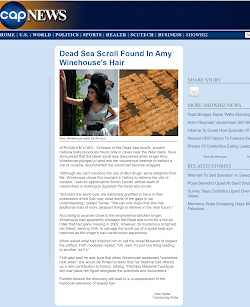
Was a Dead Sea Scroll found in Amy Winehouse's hair?

Image
  Nope, of course not!. But back in 2008, I did lead a team to digitise the Dea Sea Scrolls. It got so much press coverage at the time that it led to this charming parody news story. I'm sat bored at the airport when Facebook memories suggest this from 14 years ago today, so I checked it out and it still makes me laugh.

Finding the Arch in the archive

Image
This paper explores how and where Archbishop Desmond Tutu's life and work are represented in various archival materials. It then proposes some areas of research collaboration and value.

The revolution starts here: open access to digital cultural heritage collections in the UK

Image
A report was released this week that is the single most important piece of research conducted on the subject of copyright and cultural heritage in the UK. Conducted by Dr Andrea Wallace this work needs to signal the start of an evolution in practice for UK museums, libraries and archives with a revolution in access and re-use for the general public. As the report states, we need policy that breaks down " the barriers existing between the UK’s outstanding cultural collections, including public access to and reuse of them ".

What is a strategy?

Image
A strategy, most simply, is a plan of action designed to achieve a long-term or overall aim. It is the answer to the question ‘where are we going and why?’ Strategy differs from the everyday management processes and plans implemented as a procedure, policy or protocol that answers a different question: ‘how do we get things done around here?’ 

BVIModel.org - new impact model website launched

Image
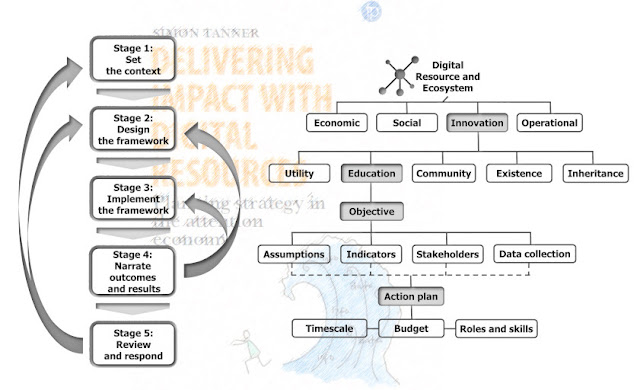
I am announcing a new web resource: the Balanced Value Impact Model . Visit for exemplars, implementations, templates, a bibliography and a glossary of the BVI Model.  BVIModel.org  also supports the release of my book:  Delivering Impact with Digital Resources .

Balanced Value Impact Model at #LibPMC

Image
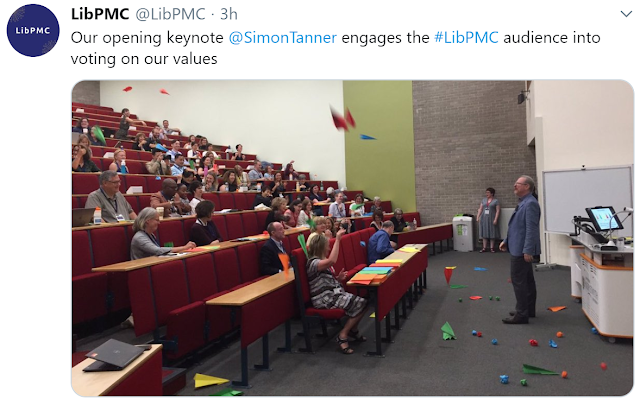
Image courtesy of @LIbPMC conference I delivered a keynote on the Balanced Value Impact Model to the International Conference on Performance Measurement in Libraries, Aberystwyth, Wales on the 23rd July 2019. See the conference hashtag #LibPMC and website  for more information.

Keynote: Proposing the modes of digital value for a memory institution

Proposing the modes of digital value for a memory institution from Simon Tanner Proposing the modes of digital value for a memory institution Keynote delivered to the Museums and Digital Memory: from creation and curation to digital preservation - a British Museum conference: Monday 3rd September 2018 #MADM2018

BVI Model Version 2 Overview

Image
The Balanced Value Impact Model (BVI Model) has been used and tested in many memory institutions since 2012. Here I publish the major modifications that make up BVI Model Version 2. The full Version 2 of the BVI Model will be published in my book: Delivering Impact with Digital Resources: Planning strategy in the attention economy due in 2019.

How much newspaper content is digitized?

Image
There is a lot of digitized newspaper out there in the world but it still seems to be a small fraction of the total newspaper collections worldwide (possibly less than 5% of all English language content by my guesswork). This blog highlights some sources and seeks more information on how much newspaper is out there and yet to be digitized?

Elsevier losses questioned in SciHub case

Image
This is a guest blog by Professor Charles Oppenheim which details some intriguing calculations from the Elsevier copyright case against Sci-Hub . Important questions are posed, will someone from Elsevier be willing to answer them?

Gold is a dead model for Open Access Books

Image
Book of the Dead of the Priest of Horus, Imhotep (Imuthes), ca. 332–200 B.C. The Metropolitan Museum of Art http://www.metmuseum.org/art/collection/search/551786 The recent final reports for the Academic Book of the Future are a revealing, well balanced account of the current and future state of scholarly monograph publishing in the UK. One feature is the close attention given to Open Access in books ( pages 175-195 in Michael Jubb's report ) . In this blog I want to unpack the consequences of Book Processing Charges in a Gold OA environment and how they would be utterly unsustainable in a future OA mandated REF environment.

Open Content from a Small Museum: DAC Open Access Images

Image
Rembrandt van Rijn (Dutch, 1606–1669). The Three Trees, 1643. Etching, drypoint, and engraving on laid paper. Only state. Plate: 212 x 280 mm. Sheet: 223 x 284 mm. DAC accession number 1951.D1.1. Gift of George W. Davison (B.A. Wesleyan 1892), 1951. Open Access Image from the Davison Art Center, Wesleyan University (photo: R. Lee) Guest post by Rob Lancefield , Manager of Museum Information Services, Davison Art Center, Wesleyan University Does a museum have to be large to offer open content? The Davison Art Center at Wesleyan University holds some 25,000 works on paper and has three museum staff (2.5 FTE). The collection serves teaching, study, research, exhibition, and other educational purposes. In 2012, we launched the DAC Open Access Images policy .

Illustrating the special importance of books to the Arts and Humanities

Image
The importance of books is clear for the Arts and Humanities in the UK as indicated by approximately ¼ of all submissions to the REF in book form and in addition book chapters remain an important factor in submission. These heatmap visualisations for the Academic Book of the Future quickly illustrates the stark differences in forms of scholarly communication across UK HE.

Reshaping the REF balloon - the Stern Review

Image
Source:  https://flic.kr/p/8hHczB Trying to make a change to the REF whilst not breaking it is akin to squeezing a balloon. Press or reshape too much and it bursts, but solving a problem by squeezing in one area produces bulges elsewhere. And so we come to the Stern Review - an independent review of the Research Excellence Framework (REF) - that was published this week. [ link ]

Open GLAM: The Rewards (and Some Risks) of Digital Sharing for the Public Good

Image
Figure 1:  img_japanese04, Bridgestone Museum of Art, 17.146 px/in, 2016. Fujishima Takeji, 1867-1943, Black Fan, 1908-1909, Oil on canvas, 63.7 x 42.4 cm, Bridgestone Museum of Art, Tokyo. This digital surrogate is © Bridgestone Museum of Art. Open GLAM: The Rewards (and Some Risks) of Digital Sharing for the Public Good by Simon Tanner The research-led exhibition experiment Display at Your Own Risk provides an exciting opportunity to ask some fundamental questions regarding the behavioral gaps between ‘what we say’ and ‘what we do’ in regard to museum practice and with art/images. Sometimes this is driven, as the exhibition organizers point out, by the gap between institutional policies and public understanding. By selecting 100 digital surrogate images of public domain works for this exhibition and printing them to the underlying artwork’s original dimensions this exhibition poses some interesting questions.

Burning eBooks - B&N "nukes the NOOK"

Image
Barnes & Noble is shutting down its Nook app store , (effective from March 15, 2016) through which it sold ebooks for its e-reader, the Nook. Unless Nook owners in the UK take action immediately then their ebooks (& films) could be lost to them. It is yet another example of how you don’t own your ebooks with DRM - you’re merely licensing the right to read them for a time. This announcement is a bit like a commercially driven virtual Fahrenheit 451 "fireman" is going to disable your eBooks in a fast digital fire.

Open Access to research publications - independent advice and evidence

Image
February is a month of discovery. Not just of gravitational waves but for increased evidence for Open Access, for the costs of publishing monographs and for academic journal markets. This blog focuses on the highlights of Professor Adam Tickell’s  OA report to Jo Johnson (Minister of State for Universities and Science) that has been published today, with the Minister’s response . It also mentions the Costs of Publishing Monographs report from Ithaka and the Academic journal markets report from SCONUL, RLUK, ARMA and Jisc.

What does value and impact mean?

Image
Please help me to define and understand value and impact from your perspective.

Arts & Humanities mentioned 5 times in the Nurse Review

Image
The recent Nurse Review "Ensuring a Successful UK Research Endeavour" mentions "science" 94 times and the "arts" and/or "humanities" less than half a dozen times. That's not much for arts and humanities so here are all those mentions in full.